

🇨🇦 Free shipping over $95 · $9.99 flat rate under
Yangjiang, Guangdong, China
Yangjiang has been making blades for fourteen hundred years, and Xinzuo is what that city looks like now. Hardened in a vacuum, frozen far past cryogenic, folded to seventy-three layers. Japanese shapes, and a shop of their own in Rome.
Shop Xinzuo
1400 yrs
Of blade making in Yangjiang
73
Layers folded into the flagship blades
60 HRC
Hard, and it stays that way
2025
A Star Series with Mauro Uliassi
Go south and west out of Guangzhou until the land flattens toward the sea and you come to Yangjiang, a city that has been making blades for something like fourteen hundred years. Long before stainless. Long before anyone thought to call it an industry.
Fourteen centuries of one trade does something to a place. There are grinders here whose fathers were grinders. There are people who can tell you what a blade will do by the sound it makes against the wheel. Whole streets of small workshops, doors open to the heat, throwing orange light into the road at night.
This is where Xinzuo works.
A knife is only ever as good as the moment its steel gets frozen in place.
Xinzuo harden in a vacuum, so no oxygen touches the blade while it is at temperature. Nothing scales. Nothing burns off the surface. The steel comes out as clean as it went in.
Then they take it down into cryogenic cold, far past anything a kitchen will ever see, and hold it there. That deep freeze finishes the job the fire started, converting the last soft structure left inside the blade. Skip it and a knife drifts: softens a little over the years, loses its edge sooner than it should. Do it properly and the blade you sharpen in twenty years is the blade you bought.
What comes out the other side sits at 60 on the Rockwell scale. Hard enough to hold a fine edge through a long night of prep. Not so hard that it chips the first time it finds a bone.
A great deal of damascus is a picture. Etched on with acid, printed, screened. You can always tell, because it stops where the bevel starts.
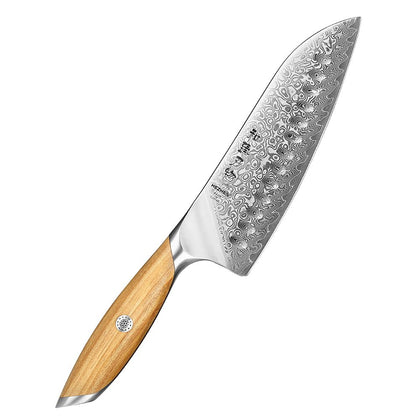
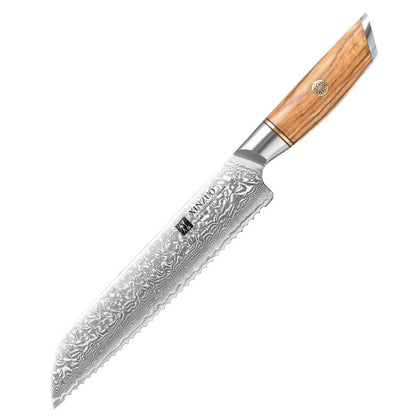
This is the real thing. Sixty-seven layers folded around a cobalt and molybdenum core. Seventy-three on the flagship blades. A hundred and ten on the Jiang Hammer. The pattern runs the whole way through the steel, so it is still there after two decades on a stone, because it is not on the blade. It is the blade.
Then there is the copper. The HEZHEN Retro line lays thirty-seven layers of damascus over a copper toned cladding, and under a kitchen light the thing looks like tortoiseshell. It is the knife guests pick up off the block and turn over in their hands without asking.
In 2025 Xinzuo went to work with Mauro Uliassi, whose restaurant on the beach at Senigallia holds three Michelin stars. What came out of it is the Star Series, built on a seventy-three layer powder steel and shaped around how a man actually cooks for a living.
They have also opened their own shop in Rome. A Chinese knife company, selling knives to Italians, in Rome. Nobody does that unless the knives hold up.
Japanese shapes, almost all of it, because that is what a serious kitchen reaches for now.
The gyuto at 8 and 8.5 inches: the chef's knife, flat enough through the belly to push cut, thin enough behind the edge to fall through an onion rather than shove it.
Santoku and nakiri for anyone who spends the evening on vegetables. The nakiri is the one nobody buys and everybody should, a tall straight rectangle of a blade that takes a cabbage apart in about a minute.
Bunka, with its reverse tanto tip, for the cook who wants one knife on the counter and wants it to do everything.
Then the specialists: honesuki for jointing a chicken, bread, filleting, utility and paring.
Across the families, B37 Lan and X01 Flagship in seventy-three layer damascus, PM8O Zhen in sixty-seven, and X05Z Zhen in ZDP-189, which is about as hard as stainless steel gets anywhere in the world. Under the HEZHEN name, the copper X05C Retro, and the PM8S Retro, a three layer composite for the cook who wants the geometry and can live without the pattern.
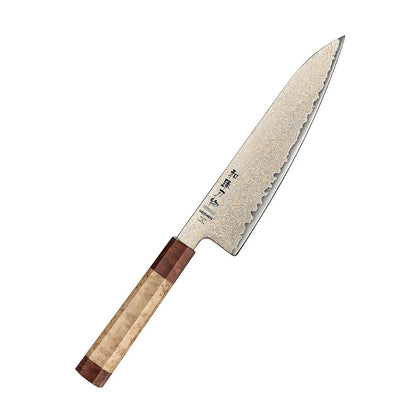
Xinzuo
$294.95
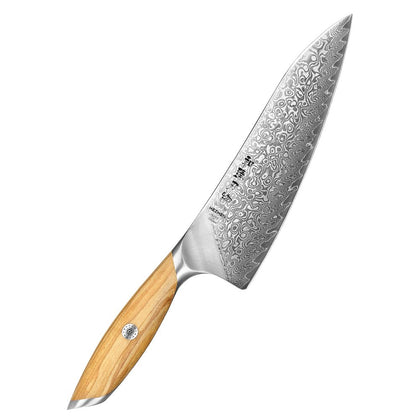
Xinzuo
$199.95
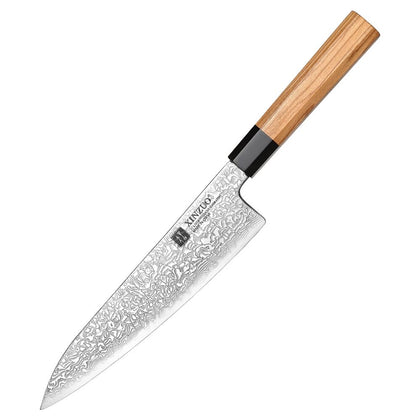
Xinzuo
$144.95
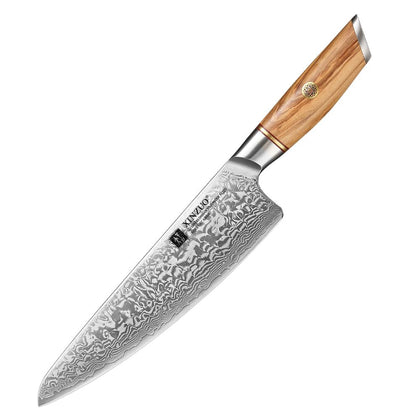
Xinzuo
$189.95
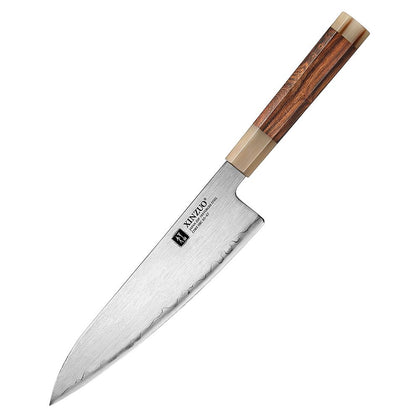
Xinzuo
$429.95
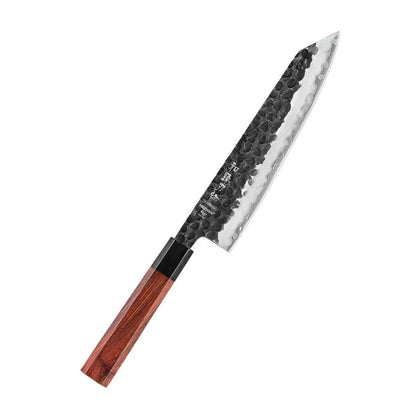
Xinzuo
$119.95
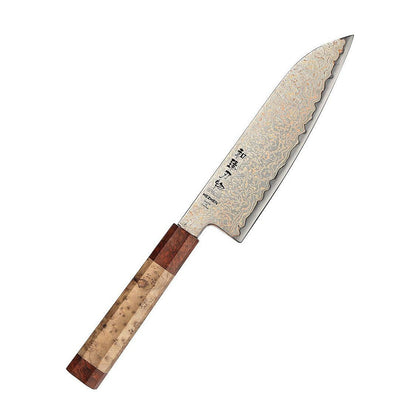
Xinzuo
$284.95
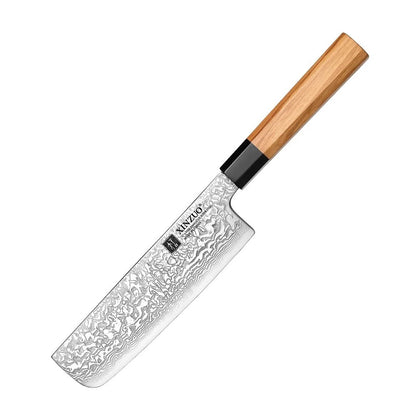
Xinzuo
$144.95
Xinzuo
$194.95
Xinzuo
$169.95

Email Us
sales@kitchenvirtue.com
No products were added to the Wishlist

[title]
[message]