

🇨🇦 Free shipping over $95 · $9.99 flat rate under
Niigata, Japan. One piece steel since 1983
Yoshida Metal Industry were already making hollow handled stainless flatware in Niigata when they asked the designer Komin Yamada for a knife. What came back had no wood, no bolster and no join. A seamless piece of steel with a sand filled handle, which is why a Global still looks like nothing else on the rack.
Shop Global
1954
the year Yoshida Metal Industry began working stainless in Niigata
1983
GLOBAL goes on sale in Japan, and abroad from 1985
500 a year
what they were making when no distributor would take it
15 degrees
the convex edge, ground both sides, in CROMOVA 18 steel
Yoshida Metal Industry began in 1954 in the town of Yoshida in Niigata, making things out of stainless steel. At the time, as the company puts it, everyone knew that a knife was carbon steel and that stainless would not cut. Their founder, Yuzo Watanabe, went the other way, and in 1960 launched a stainless kitchen knife with a wooden handle called Bunmei Gincho. Within a year it was the only knife carrying the Japan Food Hygiene Association’s recommendation.
By 1966 they had built what they describe as the only fully integrated stainless forged cutlery operation in Japan. The company is still in Tsubame, still independent, and the founder’s son runs it.
This is the part nobody tells you, and it comes straight from the current president. “Since we had experience of manufacturing hollow handle flatware, we were looking for the business opportunity to utilize this skill for developing new kitchen knives.” They already knew how to make a hollow steel handle. What they needed was someone to design a knife around one.
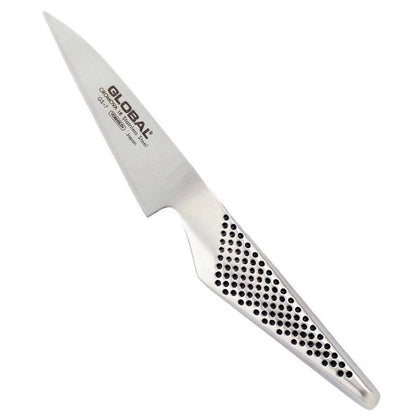
They found the industrial designer Komin Yamada and gave him a free hand. What came back, in Yoshikin’s words, came from a mind free of “the received idea that a knife has a wooden handle”: a seamless steel body with no bolster and no full tang, the handle hollow and filled with sand to put the balance where he wanted it. No join also means nowhere for food to lodge, which is the hygiene argument. The dimpled grip, black dots at home in Japan, has been the signature ever since.
Their account of where the shape came from is stranger and better than most design talk. They credit the Japanese goldfish, “with its smooth body and wide tail”, and a Zen idea about balancing irregularities rather than removing them.
It went on sale in Japan in 1983 and went abroad from 1985. Almost everyone, ourselves included until now, has only ever quoted the second date.
The knife that ended up in professional kitchens all over the world could not find anyone to sell it. Yoshikin’s own account is blunt: they took it round trading companies in Tokyo, Osaka, Kobe and Nagoya, and “no one showed interest at all”. They were making five hundred knives a year.
What changed it was one man. Mino Tsuchida was granted the overseas rights over cups of sake at a sushi restaurant the two of them used. He took the knives to Frankfurt and shared a three square metre booth with five other small companies. Then he went round retailers one at a time, sharpening and demonstrating, country by country. A colleague who was there quotes him: “I bet my everything on GLOBAL knives.” His gravestone is cut with Global’s black dots.
The blades are CROMOVA 18, chromium and molybdenum and vanadium, made to Global’s own specification, ice tempered and hardened to Rockwell 56 to 58.
The edge is the other thing separating it from a German knife. It is ground on both sides like a Western blade, but convex rather than bevelled, the hamaguri or clamshell grind, and taken to roughly fifteen degrees a side instead of the twenty you would expect out of Solingen. Thinner behind the edge, and you notice it on an onion. The SAI line goes finer again at 12.5 degrees.
Classic is Yamada’s original and still the heart of it, grown from twelve pieces to more than a hundred and fifty. G covers the longer blades, GS the small and medium ones, GF the fully forged. SAI, from 2012, is three layer steel with a hammered face and that finer 12.5 degree edge. Ukon, from 2016, takes an angular handle closer to a traditional Japanese grip, with the dots set in three rows underneath.
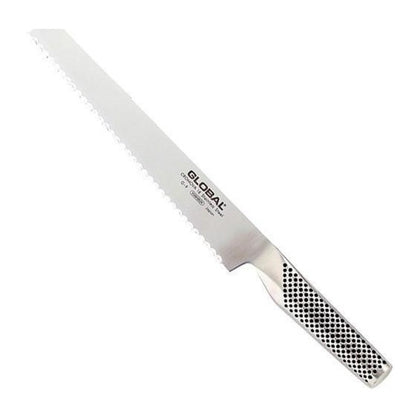
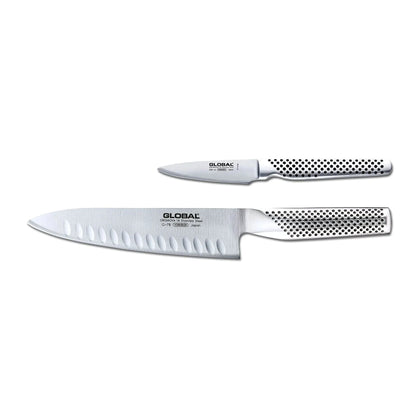
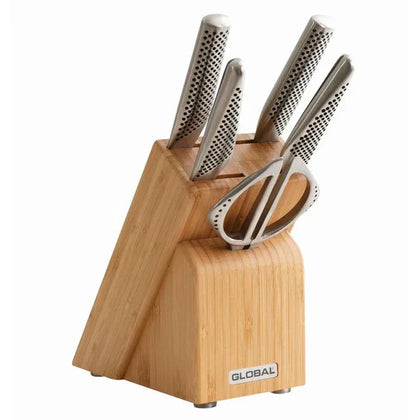
Deep on Classic. Chef’s knives from five inches to ten, the oriental chef’s, santokus plain and fluted, paring and prep knives, bread knives, carving knives and slicers, the Swedish fillet, shears and fish bone tweezers. The Takashi block set, a two piece starter set, and a Sai block.
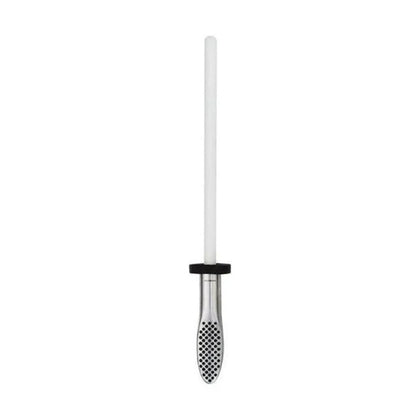
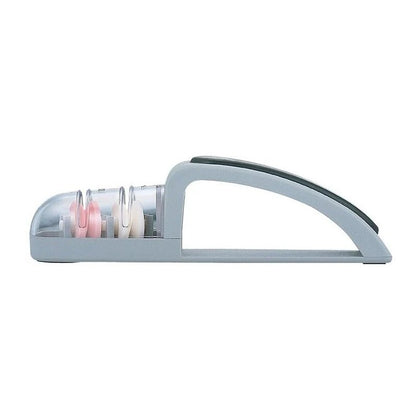
And the sharpening, which matters more with these than with most. MinoSharp is Global’s own brand, and the whetstones were designed in the factory to recreate the grind the knife left with. Use their ceramic rod rather than a traditional steel, since Global are explicit that other materials will damage the blade. And never the dishwasher.
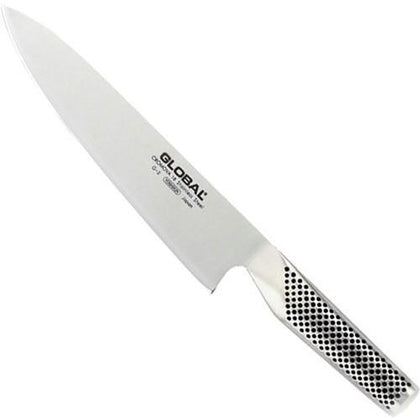
Global
$199.97
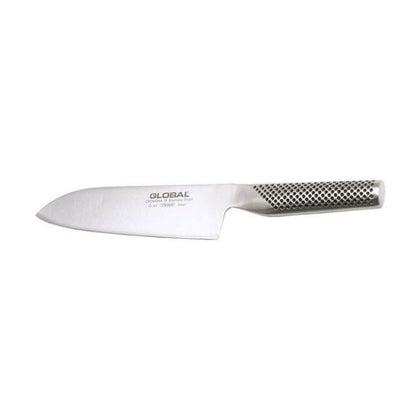
Global
$179.97
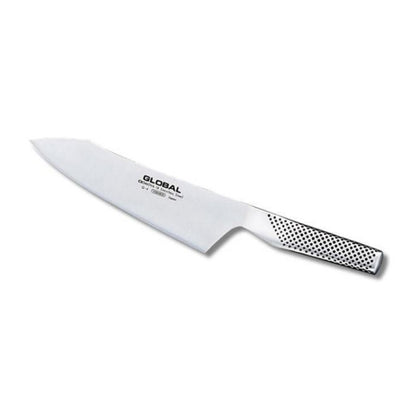
Global
$179.97
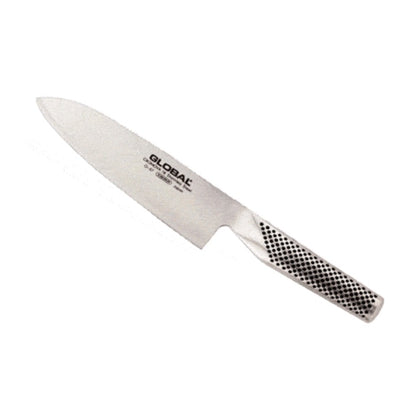
Global
$169.97
Global
$129.97
Global
$164.97
Global
$195.95
Global
$499.97
Global
$139.97
Global
$99.97

Email Us
sales@kitchenvirtue.com
No products were added to the Wishlist

[title]
[message]