

🇨🇦 Free shipping over $95 · $9.99 flat rate under
Solingen, Germany. Blades since 1814
Johann Abraham Wusthof started out making scissors in a Solingen cellar in 1814. Seven generations later the family still owns the company, and every forged knife is still made in the one city on earth whose name is a registered trademark.
Shop Wusthof
1814
the year Johann Abraham Wusthof started making scissors in a cellar
7 generations
of the same family, still running the company today
54 steps
to turn a bar of their own steel into a finished forged knife
Made in Solingen
a protected mark, and a stricter one than Made in Germany
Napoleon was still a live problem in Europe when a thirty eight year old named Johann Abraham Wüsthof turned his father’s iron workshop on the banks of the Wupper into a business with a very grand name: Shears Factory, Steel and Iron Works. Wusthof are honest about the gap between the name and the reality. “Calling it a factory was optimistic: day in and day out, our company founder toiled away in an underground cellar, making scissors.”
His three sons learned the trade. One of them, Eduard, took over and pushed the catalogue out to twelve hundred models of pocket, bread, vegetable and butcher’s knives, then thought better of it and narrowed the range right back down. Out of that came the knife the company still rests on. The Classic, in 1886, built as an affordable forged kitchen knife at a time when there was almost no such thing.
The best story Wusthof tell about themselves is Robert’s. In 1881 Eduard’s brother crossed the Atlantic with two cases of scissors and pocketknives in his luggage, on the promise of an agent who then failed to deliver. He arrived without enough money to clear his own goods through customs.
What he did next, in their words, is that he “managed to keep his head above water with odd jobs. He was a waiter, dishwasher, and glove-launderer” until he found a businessman who liked the Solingen knives enough to order double what Robert had brought. The American arm of the company is still called Wusthof Trident of America, which they note brings it “full circle from the steamboat crossing of 1881”.
Solingen has made blades since the Middle Ages, drawn there by the Wupper and the hydropower it gave the riverside workshops. In 1938 it became the only city in the world whose name is a registered trademark. To stamp a knife Made in Solingen, every key stage of manufacturing has to happen inside the city, and the knife has to meet the standard. A knife made entirely within the town boundary can still be refused the name.
Wusthof put it like this: just as you cannot make champagne outside Champagne or parmesan beyond Parma, a Solingen knife has to be made in Solingen. And they are pointed about what that has cost them. “Unlike many knife makers, in over 200 years of history, we have not succumbed to the temptation of manufacturing our forged knives outside of our hometown.”
A forged Wusthof starts as a bar of their own steel, X50CrMoV15, chrome and molybdenum and vanadium with half a percent carbon. It is heated past two thousand degrees Fahrenheit, compressed in a forge, then tempered and hardened to 58 Rockwell. After that come the honing, the fining, the handle, and a laser guided final edge at fourteen degrees a side.
Their own account of the factory is the part worth knowing. A hundred and twenty robots for the heavy and the millimetre precise work, four hundred people for everything that needs a trained eye, 1.7 million knives a year, and every one of them through the hands of a specialist before it ships.
Wusthof’s own film from the Solingen factory floor.
In 1992 Wusthof borrowed a trick from shipbuilding. They fit a small aluminium ring to the tang where the blade meets the handle. If water gets in, the aluminium corrodes instead of the steel, dissolving very slowly over decades while the blade is left alone. They call it the sacrificial anode, and by their own account the idea was copied across the industry once the patent ran out.
It buys the knife years, not immunity. Wusthof’s own first rule still stands: never put them in the dishwasher.
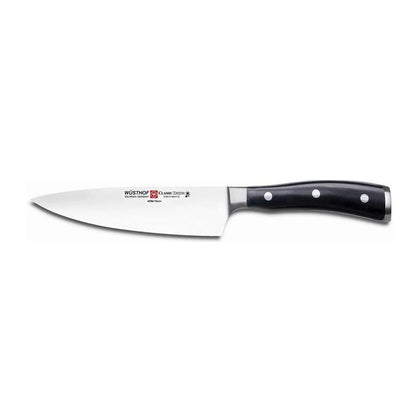
Classic is the original and the widest blade selection they make, forged, full bolster, the triple riveted black handle with the trident set into it. Classic Ikon is the same steel with a contoured handle and a double bolster, the half bolster at the heel letting you sharpen the full length of the blade. Ikon sits above both, with handles in African blackwood and the final edge honed by hand.
Below the forged lines, Gourmet and Urban Farmer are laser cut from sheet steel rather than forged, hardened to 56 Rockwell, with no bolster. Lighter in the hand, easier on the wallet, and the sensible way in.
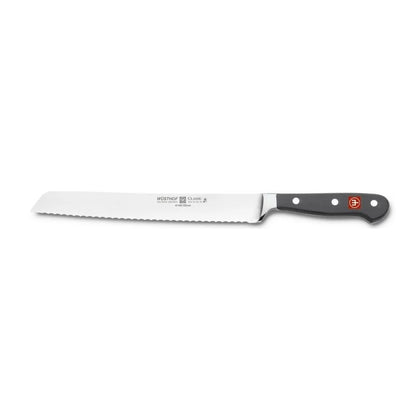
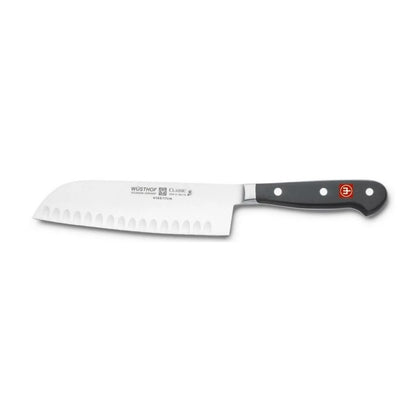
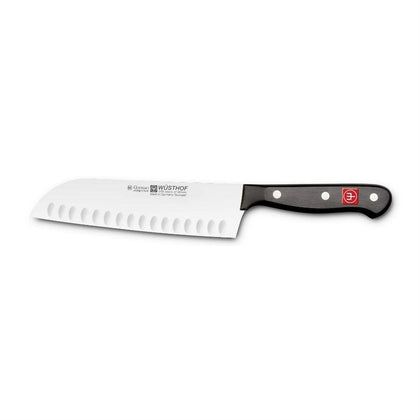
More Wusthof than anything else in the shop, better than three hundred lines of it. Classic cook’s knives from four and a half inches to ten, the paring and utility knives, bread knives, santokus, carving and steak knives, and the Classic Ikon range alongside them.
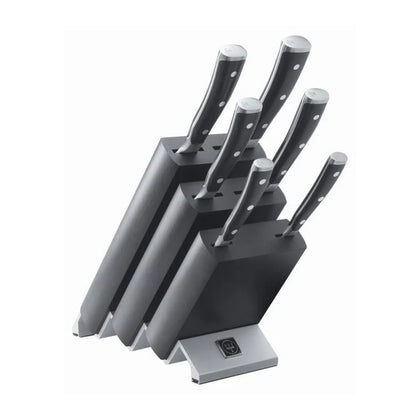
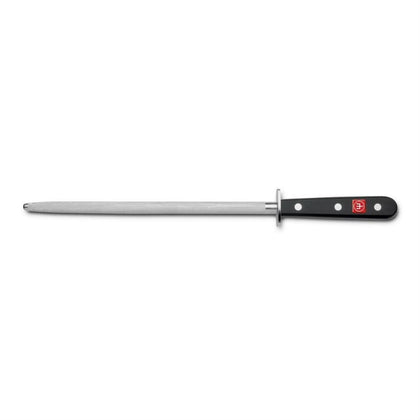
Then everything that goes around the knives: blocks in beech, ash, walnut and acacia, in drawer trays, magnetic holders, chef’s cases, blade guards, whetstones, and the sharpening and honing steels. All of it carries a limited lifetime warranty against manufacturing defects.
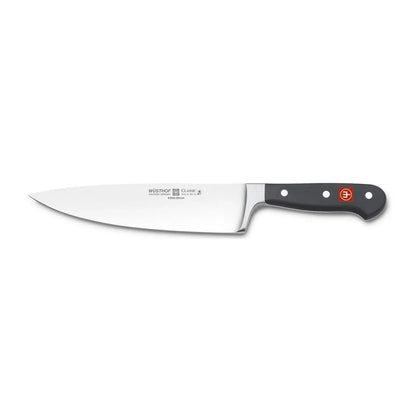
Wusthof
$220.00
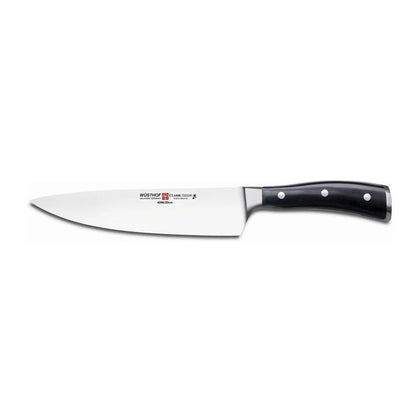
Wusthof
$265.00
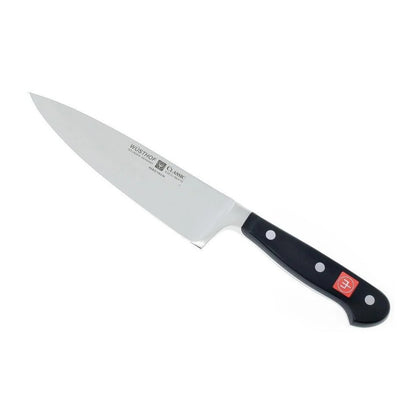
Wusthof
$190.00
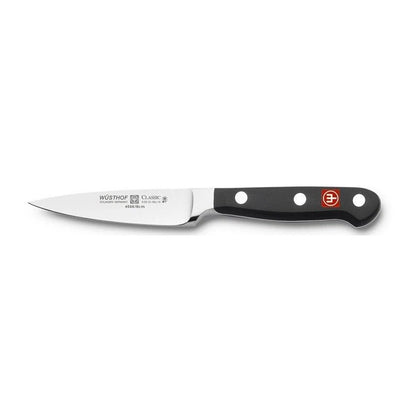
Wusthof
$130.00
Wusthof
$175.00
Wusthof
$220.00
Wusthof
$235.00
Wusthof
$1,365.00
Wusthof
$125.00
Wusthof
$180.00

Email Us
sales@kitchenvirtue.com
No products were added to the Wishlist

[title]
[message]