

🇨🇦 Free shipping over $95 · $9.99 flat rate under
Seki, Gifu. Japanese blades since 2004
Seki has made blades since the fourteenth century, swords first and kitchen knives after. In 2004 Zwilling opened its own factory there, and Miyabi is what it makes: hard cores, hand honed edges and damascus you will want to turn over under the light.
Shop Miyabi
14th c.
Seki has made blades since
100+
Steps to make a single knife
42
Days from steel to finished blade
66 HRC
The hardest blades we carry from Miyabi
Drive north out of Nagoya into the foothills of Gifu, cross the Nagara River, and you are in Seki. The town has been making blades since the fourteenth century. First swords, the long curved ones carried by men who considered them an extension of the soul. Then, when the age of the samurai ended and nobody needed a katana any more, the smiths of Seki did what good craftsmen do. They kept the knowledge and changed the object. They made kitchen knives.
They are still making them. Seki is to the Japanese blade what Solingen is to the German one, a whole town organised around steel and an edge.
So when Zwilling, the Solingen house that has been making knives since 1731, decided to make Japanese knives, there was only one place to do it. In 2004 they opened their own factory in Seki. Miyabi is what comes out of it.
A Miyabi knife takes more than a hundred separate steps and about six weeks to make. Created by hand, as they put it, with the help of machines, never by machines alone. The people doing it work to shokunin, the Japanese idea that a craftsman spends a whole working life getting a little better at one thing.
Two of those steps matter most to the cook.
The first is cold. Ice hardening is a Zwilling process, worked out in Solingen in 1939, and Miyabi blades are taken deep below freezing after the fire, twice on most of the lines we carry. It locks the steel into a hard, even structure that holds its edge and shrugs off rust. That is why these knives can run at 61 on the Rockwell scale, and the 5000 MCD 67 at 66, without turning brittle.
The second is the edge. Every blade is finished by hand on stones in the three stage Honbazuke method, down to between 9.5 and 12 degrees a side. A German chef's knife is usually ground to about fifteen. You feel the difference on the first tomato. The knife does not push through it. It falls through it.
Most Miyabi knives are built the old way: a very hard core for the edge, wrapped in dozens of layers of softer stainless that protect it and give the blade its figure. Every line has its own. Tenmei, which means daybreak, carries forty-nine layers in a pattern drawn from the sunrise. Kaizen II wears a dark flower damascus. The 5000 MCD 67 goes to a hundred and thirty-three layers around a micro carbide powder steel core, and in the light it looks like water moving over stone.
No two come out alike. Pick one up and turn it under a kitchen light and you will see why people buy a second.
Tenmei is the newest, and the one we would put in most hands. The sunrise pattern, a double ice hardened FC61 core at 61 HRC, and a black pakkawood handle with brass and red spacers, a mosaic pin and a steel end cap. Chef's knife, santoku and paring knife.
Kaizen II, whose name means change for the better. An 8 inch gyutoh with a flower damascus blade over an FC61 core and a rounded D shaped handle. The ideal first Japanese knife for a cook coming from German steel.
800 DP Hibana keeps a Western handle and a curved bolster for anyone who likes a pinch grip, with a forty-nine layer spark damascus blade. Chef's knives, santoku and a rocking santoku, a nakiri for vegetables, a bread knife and a paring knife.
Mikoto has a blade with a diamond pattern brought up by acid and an octagonal handle that sits easily in either hand. Chef's knife, santoku, nakiri and paring knife.
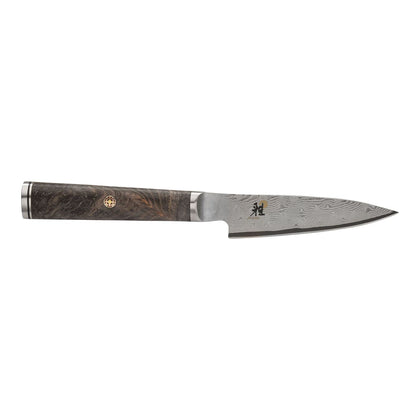
5000 MCD, the Birchwood line, pairs a powder steel core with a pale birch handle, in gyutoh and santoku. And 5000 MCD 67, the top of the house: 66 HRC, a hundred and thirty-three layers and a black ash handle. Gyutoh at 8 and 9.5 inches, santoku, and shotoh paring knives at 3.5 and 5 inches.
Miyabi is part of the Zwilling family, made in Seki for the house in Solingen. Hand wash and dry them, keep them off glass and stone, and they will repay it for the rest of your cooking life.
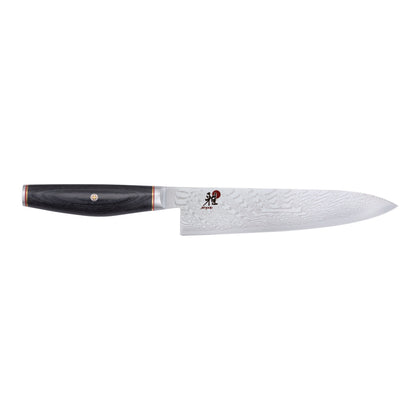
Miyabi
$349.97
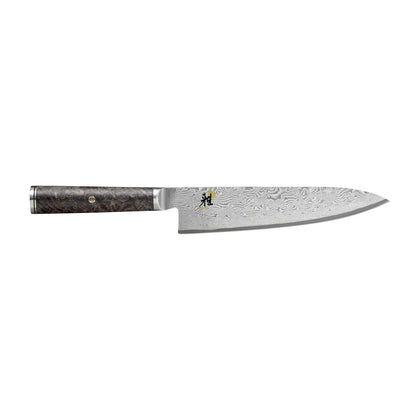
Miyabi
$619.97
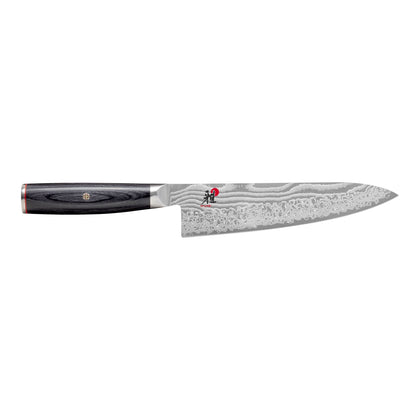
Miyabi
$299.97
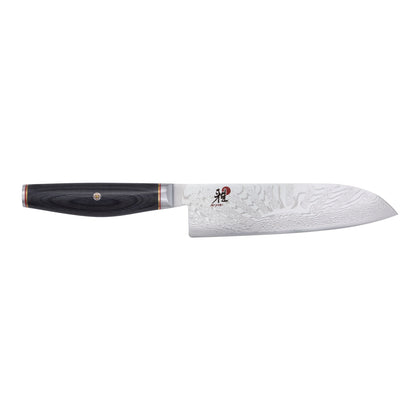
Miyabi
$349.97
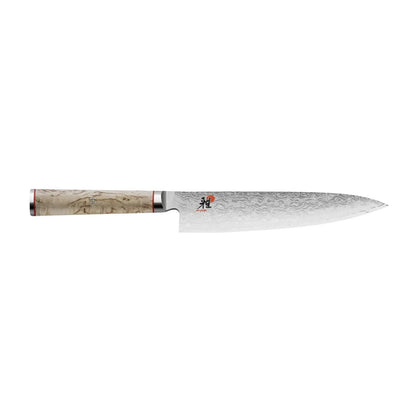
Miyabi
$499.97
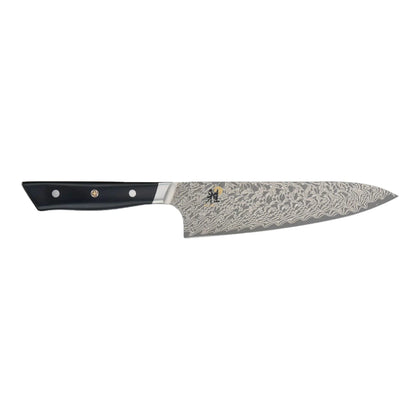
Miyabi
$299.97
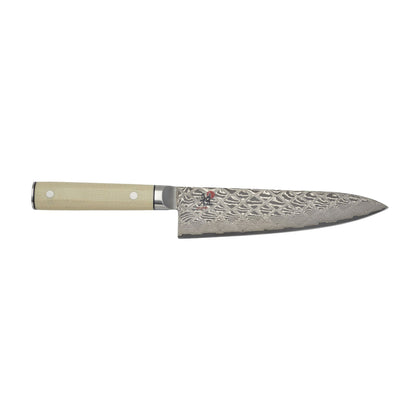
Miyabi
$419.97
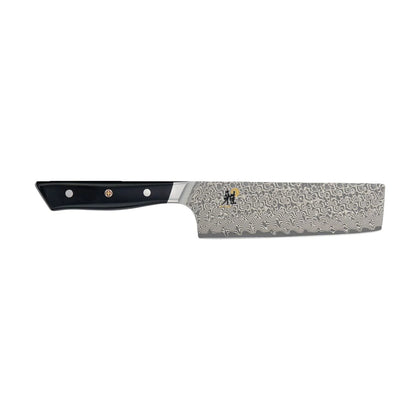
Miyabi
$299.97
Miyabi
$399.97

Miyabi
$249.97

Email Us
sales@kitchenvirtue.com
No products were added to the Wishlist

[title]
[message]